The Science of Rehearsing the Future: How Science Fiction Trains Strategic Imagination
A Practical Futures White Paper by Pawel Halicki
April 2026 | Version 1.1
This white paper is licensed under CC BY-NC 4.0. You're free to share and reference it with attribution.

Executive Summary
Every organisation has a strategy department. None has an imagination department. Most individuals invest in skills training but rarely in the capacity to envision what those skills will be worth in five years. This gap, between the rigour applied to analysing the present and the capacity to inhabit possible futures, carries measurable costs.
A longitudinal study of large enterprises across industries found that firms with mature foresight capabilities achieved 33% higher profitability and 200% greater market capitalisation growth (Rohrbeck & Kum, 2018). The World Economic Forum's Future of Jobs Report 2025 identifies creative thinking as one of the fastest-growing workforce skills by 2030, rising faster than analytical thinking or leadership (World Economic Forum, 2025). Yet most organisations treat strategic imagination as individual talent rather than a trainable capability. Most individuals never encounter a structured method for developing it at all.
Neuroscience suggests a different framing. Humans are, at their core, prospecting beings. The brain devotes substantial resources to simulating possible futures, a capacity researchers have termed Homo Prospectus (Seligman et al., 2016). Episodic future thinking, the brain's ability to mentally pre-experience possible scenarios, is not a fixed trait but a trainable skill (Szpunar, 2010). A meta-analysis of 47 studies found that future thinking interventions produce reliable improvements in decision-making and behavioural outcomes, with an effect size of g = 0.52 (Ye et al., 2022). The mechanism: vivid future simulation shifts neural valuation of distant outcomes, reducing the cognitive discount rate that leads to short-term bias.
Practical Futures is a platform that operationalises this research through a defined system of tools. The system rests on a clear architecture:
Business Sci-Fi is the content format. Short fiction that makes the future relatable by grounding technological and social change in everyday situations that already feel familiar: performance reviews, morning commutes, team meetings, family dinners.
Narrative Microdosing is the training method. Business Sci-Fi is delivered at regular intervals together with reflection prompts grounded in the episodic future thinking approach. Rather than occasional workshops or abstract scenarios, practitioners engage with brief stories paired with "memory from the future" prompts that connect fictional scenarios to current decisions and contexts.
Futures Gradient is the output. What individuals or organisations build by combining their answers to reflection prompts over time. The Futures Gradient is mineable for patterns and insights grounded in personal or organisational context, creating a cumulative record of evolving strategic imagination.
Three converging evidence streams support this approach. First, positive, plausible future scenarios outperform neutral or negative ones in shifting behaviour (g = 0.64 vs. -0.03 for negative valence). Second, narrative transportation — immersion in story — reduces counterarguing and creates belief change through experiential processing rather than analytical evaluation (Green & Brock, 2000). Third, pattern library development through repeated scenario exposure builds expert-like recognition capabilities, enabling faster and more accurate responses when anticipated conditions materialise (Klein, 1998).
This white paper synthesises evidence across cognitive neuroscience, behavioural economics, narrative psychology, and organisational foresight to explain why narrative-based futures training works and how individuals, organisations, and practitioners can begin building the capacity to thrive in uncertainty.
1. The Strategic Imagination Gap
Organisations invest heavily in prediction. Market research, competitive intelligence, financial modelling, trend analysis: billions flow annually into understanding what will happen. Individuals invest in credentials, certifications, and skills training aligned with current market needs. Consultants and facilitators build practices around established methodologies with proven track records. Yet prediction consistently fails precisely when it matters most: at inflection points, during disruption, when the future refuses to resemble the past.
The limitation is not analytical rigour. It is imaginative range. Strategic imagination is the practiced ability to mentally rehearse possible futures and use what is learned to make better decisions under uncertainty.
1.1 The Foresight Performance Gap
The business case for strategic imagination is no longer speculative. Rohrbeck and Kum's (2018) longitudinal study of over 70 large enterprises found stark performance differences between organisations with mature foresight practices and those without. Firms demonstrating systematic futures capabilities, like environmental scanning, scenario thinking, and strategic vision alignment, achieved 33% higher profitability and 200% greater market capitalisation growth over the study period.
Yet most organisations lack the infrastructure to develop these capabilities at scale. Strategy remains centralised. Imagination stays personal. Futures thinking operates as executive privilege rather than distributed competence, and for individuals outside organisational structures, the tools are even less accessible.
1.2 Why Traditional Approaches Fall Short
Scenario planning, the dominant methodology since Shell's pioneering work in the 1970s, produces valuable outputs but struggles with sustained adoption. Elaborate scenario exercises create intellectual understanding without behavioural change. Leaders nod at plausible futures, then return to quarterly targets. The problem is not the scenarios, but the mechanism of engagement.
Speculative design and design fiction offer much richer experiential qualities but require dedicated resources to develop prototypes, videos, or immersive installations. These methods work brilliantly for teams with allocated budgets, but they are often hard to scale across organisations.
Strategic foresight provides rigorous theoretical foundations but demands substantial training and disciplinary knowledge. The depth is equally as genuine as the accessibility barrier is real.
The gap: no accessible, lightweight, systematic approach exists for building futures literacy, as an individual practice, or a distributed organisational capability.
1.3 The Psychological Barrier
Beyond methodology, a deeper obstacle exists. Humans discount the future systematically. Decades of behavioural economics research document our preference for immediate rewards over larger delayed ones, a tendency that shapes everything from personal savings to corporate strategy (Peters & Büchel, 2010).
This is not a character flaw. It is a neural architecture. The brain evolved for immediate environments where distant futures rarely materialised as imagined. Ancestral conditions rewarded present focus. The cognitive machinery persists today.
The consequence is universal: even when individuals and leaders intellectually understand long-term threats and opportunities, the felt urgency of immediate pressures overwhelms distant considerations. Strategic plans gather dust not because they are wrong but because they do not feel as real as this quarter's numbers, this week's client deliverable, or today's inbox.
1.4 The Emerging Requirement
The World Economic Forum's Future of Jobs Report 2025 projects that 39% of existing skill sets will be transformed or become obsolete by 2030, identifying creative thinking as one of the fastest-growing workforce skills, ahead of analytical thinking or leadership (World Economic Forum, 2025). UNESCO has reached a parallel conclusion, establishing futures literacy as a formal capability since 2012, with over 110 Futures Literacy Laboratories operating across 44 countries (UNESCO, 2024).
As AI commoditises routine cognitive work, the capacity to envision alternatives becomes a scarce resource. Yet organisations continue optimising for productivity while neglecting imagination. Individuals continue optimising for current competencies while the half-life of those competencies accelerates. Consultants and facilitators deliver episodic interventions without a continuity infrastructure. The tools exist for measuring and improving operational efficiency. Equivalent infrastructure for strategic creativity remains undeveloped.
Business Sci-Fi addresses this gap: a content format for training strategic imagination that scales across contexts, requires minimal time investment, and operates through mechanisms the brain already uses to learn about possible futures. Delivered through the Narrative Microdosing method and accumulated in the Futures Gradient, it forms the foundation of a systematic practice accessible to anyone navigating uncertainty.
2. The Architecture of the Method
Business Sci-Fi is strategic fiction designed to train imaginative capacity. Unlike science fiction written for entertainment or speculative design created for critique, Business Sci-Fi exists to help individuals and teams mentally rehearse futures before they arrive.
The method operates through Narrative Microdosing: systematic exposure to brief, focused stories that accumulate into an expanded imaginative range over time. Rather than intensive workshops that create momentary insight, Narrative Microdosing builds durable capability through repetition and reflection. The cumulative output — the Futures Gradient — becomes a structured record of evolving strategic intuition, mineable for patterns and actionable insights.
2.1 The Core Mechanism
Each engagement follows a defined structure:
Story. A short narrative, typically five minutes to read, depicting an emerging technology or social shift integrated into a familiar context. Not dystopian speculation or moonshot fantasy, but everyday moments where tomorrow's changes actually matter. A performance preview conducted with AI-mediated emotional intelligence. A morning commute where the transit system uses differential privacy for mentoring opportunities. A family dinner where the kitchen anticipates the mood. The mundane is deliberate: it is where the future is actually experienced.
Reflection. "Memory from the future" prompts that connect the fictional scenario to the reader's actual context: personal, professional, or organisational. These prompts operationalise episodic future thinking research by asking readers to mentally simulate their own experience within the scenario's conditions. Not "what do you think about this future?" but "how would you handle your team's first AI-augmented performance cycle?" or "what would this shift mean for the clients you serve?"
Accumulation. Repeated engagement across scenarios builds pattern libraries, the mental models that enable rapid recognition and response when anticipated conditions begin materialising. Each set of reflection responses feeds the Futures Gradient, creating over time a layered map of how an individual's or organisation's futures thinking evolves. Strategic imagination develops not through analysis but through simulated experience made visible and reviewable.
This approach draws on a growing body of practice in design fiction and experiential futures. Bleecker and colleagues position design fiction as the creation of tangible, evocative artefacts from possible near futures that surface the consequences of present-day decisions (Bleecker et al., 2022). Candy's framework of experiential futures extends this further, arguing that futures work becomes effective when it shifts from informing people about possible futures to immersing them in those futures, designing situations and artefacts that catalyse insight through felt experience rather than analytical description (Candy, 2010). Business Sci-Fi builds on those concepts with a specific focus: rather than physical artefacts, installations, or prototypes, it uses short narrative as the experiential medium that scales to any individual, team, or organisation without additional production overhead.
2.2 What Makes It "Business"
The distinction from general science fiction is deliberate and functional. Business Sci-Fi focuses on:
Second and third-order effects, rather than the technology itself. Not "what if we had humanoid robots?" but "what happens to service industry economics when labour costs approach zero?", or “where would you keep your robot?” The strategic implications matter more than the technical specifications.
Organisational, market, and personal dynamics rather than individual adventures. Characters navigate workplace politics, competitive pressures, regulatory shifts, career inflections, and client relationships. The futures depicted are inhabited by people doing jobs, running practices, and making decisions, not heroes saving dystopian worlds from zombie apocalypse.
Near-term plausibility rather than distant speculation. Business Sci-Fi extrapolates from existing trajectories, technologies already in development, social patterns already emerging, and business models already being tested. The horizon is years, not centuries. Foster describes this orientation as the future mundane, where the most useful speculation depicts not spectacular breakthroughs but the ordinary texture of life under changed conditions: the background characters, the legacy systems that persist alongside new ones, the things that break (Foster, 2025). Business Sci-Fi adopts this principle: its scenarios are set in performance reviews, commutes, and family dinners precisely because this is where the future is actually lived.
Protopian rather than dystopian framing. Research consistently shows that positive future scenarios produce stronger behavioural effects than negative ones (Ye et al., 2022). Business Sci-Fi depicts futures worth building, not utopian perfection, but genuine progress with realistic friction. The goal is motivation and preparation, not just warning.
3. The Evidence Base
The scientific foundation for narrative-based futures training draws from six converging research streams. Each addresses a different dimension of the question: how do humans learn to navigate uncertainty, and how can this capacity be cultivated systematically?
3.1 Episodic Future Thinking: How the Brain Constructs Tomorrow
The brain does not store the future, but builds it. Cognitive neuroscience has identified episodic future thinking (EFT) as the constructive process through which humans mentally simulate possible experiences (Szpunar, 2010). This capacity relies on the same neural architecture used for episodic memory: the hippocampus, medial prefrontal cortex, and posterior parietal regions work together to assemble elements from experiences into novel future configurations (Benoit & Schacter, 2015; Szpunar, 2010).
The construction is literal, not metaphorical. Neuroimaging studies show that imagining a future event activates the same brain regions as remembering a past one. The hippocampus retrieves stored elements, like people, places, objects, or emotions, while the prefrontal cortex recombines them into coherent scenarios. Most patients with hippocampal damage who cannot form new memories also struggle with imagining detailed futures.
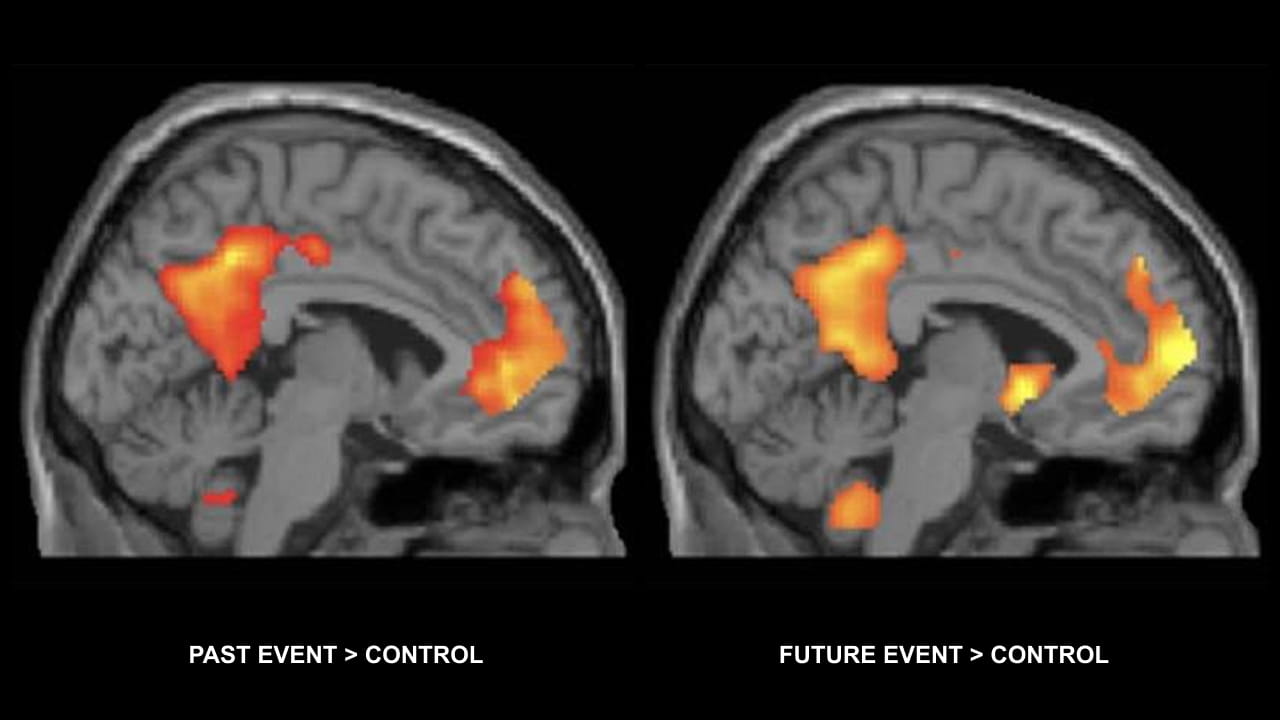
Figure 1. fMRI activation contrasts for past and future event simulation versus control. Orange-red regions indicate significantly greater activation. The near-identical spatial distribution of activity during past memory retrieval (left) and future event construction (right) illustrates the shared neural architecture underlying episodic future thinking (Szpunar, 2010).
What the brain scans show.
When participants are asked to remember a past event or imagine a future one, nearly identical regions light up, particularly the medial prefrontal cortex and posterior cingulate. The brain does not have a separate "future department." It constructs futures using the same architecture it uses to reconstruct the past. This is why the quality and diversity of past experiences (including simulated experiences from vivid fiction) directly determines the richness of the futures you can build.
Szpunar (2010) proposes an important refinement: future thought construction draws not only on episodic memory (specific personal experiences) but also on semantic memory (generalised world knowledge). Their relative contributions depend on the accessibility of information in memory, meaning that a richer store of conceptual knowledge about possible futures directly expands the range of futures the brain can construct. This provides a precise neural rationale for the element-library mechanism: Business Sci-Fi stories function as semantic memory deposits, broadening the raw material available for future simulation.
This architecture sits within a broader reconceptualisation of human cognition. Seligman and colleagues (2016) propose that humans are best understood not as Homo sapiens (the knowing species), but as Homo prospectus — the prospecting species. This reconceptualisation builds on earlier work by Suddendorf, Addis and Corballis, who demonstrated that the capacity for mental time travel (mentally projecting oneself into past and future episodes) shares a core neural network and may have been a primary driver of human cognitive evolution, including the emergence of language itself (Suddendorf, Addis & Corballis, 2009).
Research suggests that roughly three-quarters of future-directed thoughts involve planning and preparation, and that the brain's default network, active during rest and mind-wandering, is substantially occupied with prospective simulation (Baumeister, Vohs & Oettingen, 2016). Prospection is not an occasional cognitive luxury, but the brain's baseline operation.
Crucially, this prospective capacity is trainable. Affective forecasting research demonstrates that people are often poor at predicting how future events will make them feel, but that structured training in prospection can improve accuracy and reduce systematic biases (Seligman et al., 2016). The implication is direct: the quality of future thinking depends on the quality of the raw material available and the frequency of practice.
Why this matters for methodology.
Exposure to diverse, vivid stories expands the element library available for future construction. Each Business Sci-Fi story deposits new components, technological possibilities, social configurations, and organisational dynamics that the brain can later retrieve and recombine when constructing its own futures. It does not teach what to think about the future, but provides building blocks for thinking about futures that you wouldn’t previously have been able to construct.
3.2 Prospection and Decision-Making: Shifting What the Future Is Worth
Humans systematically undervalue future outcomes. This temporal discounting (preferring smaller immediate rewards over larger delayed ones) shapes decisions from personal savings to corporate strategy. The pattern is so robust that behavioural economists model it mathematically: a reward's subjective value decays hyperbolically with delay.
But the discount rate is not fixed. A landmark finding in prospection research demonstrates that episodic future thinking reduces delay discounting. When people vividly imagine themselves in a future scenario, distant outcomes feel more real and more valuable. Peters and Büchel (2010) demonstrated this mechanism using neuroimaging, showing that EFT engages the brain's valuation circuitry in ways that shift the subjective worth of future rewards. The meta-analysis by Ye and colleagues (2022) quantified this effect across 47 studies: future thinking interventions produce a reliable moderate effect (g = 0.52) on reducing impulsive decision-making.
The neural mechanism is increasingly understood. Future simulation engages the ventromedial prefrontal cortex (the brain's valuation centre) in ways that abstract reasoning does not. While thinking analytically about the future informs belief, imagining oneself in the future shifts motivation.
The brain responds to futures worth wanting.
Crucially, the emotional valence of the imagined future (positive, neutral, or negative) moderates the effect size. Positive future scenarios produce substantially larger effects (g = 0.64) than neutral scenarios (g = 0.32), whereas negative scenarios produce almost no effect (g = −0.03). The brain responds to futures worth wanting.
Why this matters for methodology.
Business Sci-Fi's emphasis on protopian scenarios, futures worth building rather than dystopian warnings, aligns directly with this evidence. Positive framing is a mechanistic design, not naive optimism. Scenarios depicting functional, desirable futures engage the valuation circuitry that shifts behaviour. Apocalyptic speculation may generate intellectual engagement, but it fails to move the motivational needle.
3.3 Narrative Transportation: How Stories Bypass Resistance
Stories operate differently from arguments. When people read fiction, they enter a state researchers call narrative transportation, a convergent experience of cognitive attention, emotional engagement, and mental imagery that feels like being absorbed into a narrative world (Green & Brock, 2000). This state has measurable consequences for belief and attitude change.
Readers do not argue with a story the way they argue with a forecast.
Transportation reduces counterarguing. The analytical scrutiny people normally apply to persuasive claims diminishes during story immersion. Readers do not evaluate narrative claims the way they evaluate propositional arguments — they experience them. Post-transportation, beliefs often shift without the reader consciously noticing the persuasive mechanism.
Meta-analytic evidence confirms the effect across diverse contexts. Braddock and Dillard's (2016) meta-analysis found that narrative messages produce reliable persuasive effects, with transportation serving as a key mediating mechanism. Van Laer and colleagues' analysis of 76 studies demonstrated that narrative transportation reliably produces changes in cognitive and affective responses. The mechanism appears distinct from analytical persuasion. Stories create belief change through experiential processing rather than logical evaluation.
Identification amplifies the effect. When readers connect with characters, seeing themselves in the protagonist's situation, the transportation deepens. Futures scenarios featuring relatable contexts and unnamed characters (allowing readers to self-insert) leverage this dynamic deliberately.
Why this matters for methodology.
Resistance to futures thinking, whether in organisations, among individual practitioners, or within consulting engagements, often stems from analytical objections: "that won't happen", "our industry is different", "the timeline is wrong". These objections engage rational critique. Narrative transportation circumvents this resistance by shifting the processing channel. Readers do not argue with a story the way they argue with a forecast. Business Sci-Fi uses fiction's experiential pathway to deposit future possibilities that analytical foresight cannot plant.
3.4 Experience-Taking and the Temporal Dynamics of Fiction
Narrative transportation explains how stories reduce resistance. A complementary line of research explains how they produce lasting change, often in ways that unfold over time rather than immediately.
Kaufman and Libby (2012) identified a phenomenon they term experience-taking. When readers become sufficiently absorbed in a narrative, they do not merely observe the protagonist's experience. They simulate it from the inside, adopting the character's perspective, goals, and emotional responses as if they were their own. This goes beyond empathy or identification. Experience-taking is a first-person cognitive rehearsal triggered by a third-person narrative. Crucially, the researchers found that experience-taking produces measurable changes in readers' subsequent attitudes and behaviours, even when the narrative is explicitly fictional. This finding has direct implications for futures training. Reading about a character navigating an AI-augmented workplace does not merely inform the reader about a possible future but allows the reader to rehearse navigating that future. The third-person format of fiction paradoxically enables first-person learning.
Equally significant is the temporal dimension of fiction's influence. Bal and Veltkamp (2013) demonstrated what researchers call the sleeper effect in narrative persuasion: fiction's impact on attitudes and beliefs often increases over days and weeks after reading, rather than diminishing. Immediately after reading, the fictional source may be discounted ("it's just a story"). Over time, the experiential memory persists while the source tag fades, allowing the simulated experience to integrate into the reader's working model of reality.
Mar and Oatley (2008) provide a theoretical framework for these effects, proposing that narrative fiction functions as a form of social simulation, a cognitive workout that exercises the same capacities used in navigating real social complexity. Their research demonstrates that fiction readers develop measurably stronger social cognition, not because stories teach social rules, but because they provide simulated practice in social reasoning.
Reading about a character navigating an AI-augmented workplace does not merely inform the reader about a possible future but allows the reader to rehearse navigating that future. The third-person format of fiction paradoxically enables first-person learning.
A further dynamic operates through what might be called the psychological distance paradox. Fiction's explicit unreality (the fact that it is clearly not real) paradoxically reduces defensive processing. Oatley (1999) identified this as a distinctive property of fiction as cognitive simulation: because fiction does not assert propositional truth, it bypasses the evaluative scrutiny that direct claims provoke. Djikic and colleagues (2009) demonstrated the effect experimentally, showing that fiction can subvert habitual emotional disengagement even in readers with avoidant attachment styles, individuals whose defensive processing would ordinarily block attitudinal change. Readers who would resist a direct argument about how AI will transform their industry engage openly with a story exploring the same territory, precisely because the fictional frame removes the personal threat. The defences come down because nothing is at stake. The learning persists because the brain does not clearly distinguish simulated from actual experience when building its model of possibilities.
Why this matters for methodology.
The Narrative Microdosing approach (regular engagement over time rather than single intensive exposure) aligns precisely with these temporal dynamics. Fiction's influence builds rather than decays. Each story session deposits experiential material that integrates gradually into the practitioner's working model of possible futures. The Futures Gradient captures and makes visible this cumulative development, transforming an invisible cognitive process into a reviewable record.
3.5 Naturalistic Decision-Making: Building the Pattern Library
How do experts make rapid, accurate decisions in complex, time-pressured situations? Research on naturalistic decision-making reveals that expertise operates through pattern recognition rather than analytical deliberation. Experienced firefighters, military commanders, and emergency physicians do not systematically weigh options — they recognise situations as instances of familiar types and retrieve appropriate responses (Klein, 1998).
Klein's recognition-primed decision model describes this process: experts rapidly assess situations, match them to patterns developed through experience, mentally simulate the most plausible response, and act. The quality of decisions depends on the richness of the pattern library, the mental inventory of situations previously encountered or simulated.
This model explains both how expertise develops and how it can be accelerated. Real-world experience builds patterns slowly and haphazardly, constrained by whatever situations actually occur. Simulated experience, through case studies, scenario exercises, or narrative immersion, can systematically expand the pattern library with situations that have not yet occurred but might.
The quality of decisions depends on the richness of the pattern library, the mental inventory of situations previously encountered or simulated.
Supporting evidence comes from simulation training research. Mitchell and Ivimey-Cook's (2023) meta-analysis of technology-enhanced simulation in health professions education, encompassing 59 randomised controlled trials, found a large overall effect size (g = 0.80) when comparing simulation to traditional teaching methods. The RAND Corporation's research on simulation fidelity adds a crucial nuance: psychological fidelity (the degree to which a simulation engages realistic cognitive and emotional processing) matters more than physical fidelity (the visual or material realism of the simulation environment). A simple scenario that feels cognitively real outperforms an elaborate simulation that does not engage authentic decision-making.
The premortem technique, developed by Klein and studied empirically by Mitchell, Russo, and Pennington (1989), demonstrates another dimension of simulated future experience. By asking teams to imagine that a project has failed and then work backwards to identify reasons, prospective hindsight increases the number of potential causes identified by approximately 30% compared to standard risk assessment. The mechanism is episodic simulation: imagining a concrete future outcome (failure) and then constructing a narrative explanation generates more thorough analysis than abstractly listing what might go wrong.
Why this matters for methodology.
Each Business Sci-Fi story represents a pattern candidate. Repeated engagement across diverse futures builds an inventory of recognisable situations: the AI-mediated performance review, the algorithm-driven career pivot, the human-machine collaboration dynamic. When these patterns begin materialising in actual experience, practitioners do not encounter them cold. They recognise them.
The RAND finding on psychological fidelity validates the text-based approach: Business Sci-Fi does not need virtual reality or elaborate props. It needs scenarios that engage authentic cognitive processing, which a vivid, relatable narrative reliably achieves.
Kirby's concept of the diegetic prototype provides a complementary lens: technologies depicted within a fictional narrative as functioning, everyday objects, not showcased but simply used, demonstrate a technology's need, viability, and implications to audiences in ways that technical specifications cannot (Kirby, 2010). Each Business Sci-Fi story functions as a collection of diegetic prototypes, embedding emerging technologies within mundane contexts so that readers experience them as already real.
3.6 Organisational Foresight: The Performance Evidence
The preceding research streams establish cognitive mechanisms. Does systematic futures practice actually improve organisational performance?
The most rigorous evidence comes from Rohrbeck and Kum's (2018) longitudinal study tracking over 70 large enterprises over the study period. Companies were assessed on foresight maturity: the presence and sophistication of practices including environmental scanning, scenario development, strategic vision alignment, and organisational integration of futures thinking.
The performance differences were substantial. Firms in the top third of foresight maturity achieved 33% higher profitability and 200% greater market capitalisation growth compared to those in the bottom third. The relationship held after controlling for industry effects and company size.
The study also identified the most valuable foresight capabilities. Peripheral vision (the ability to detect weak signals at the edges of the organisation's attention) distinguished high performers. So did the integration of foresight outputs into actual strategic decision-making, rather than treating futures work as an isolated intellectual exercise.
The World Economic Forum's Future of Jobs Report 2025 reinforces the urgency. With 39% of current skill sets projected to transform or become obsolete within five years, the report explicitly calls for organisations to invest in anticipatory capabilities and creative thinking at all levels, not merely in executive suites or innovation labs (World Economic Forum, 2025).
Why this matters for methodology.
The Rohrbeck findings validate the business case for organisational foresight but do not specify how to build it. Traditional approaches, dedicated foresight units, periodic scenario exercises, and executive retreats concentrate capability in small groups. The Practical Futures system offers a distribution mechanism: futures literacy as a distributed competence rather than a specialised function. The research shows that foresight capability matters.
Jasanoff and Kim's concept of sociotechnical imaginaries: collectively held, institutionally stabilised visions of desirable futures, offers a framework for understanding how individual imagination aggregates into organisational capability (Jasanoff & Kim, 2015). When individuals within an organisation share a richer repertoire of imagined futures, the collective imaginary becomes more adaptive and more resilient.
The Futures Gradient, by making individual reflection responses visible at a group level, provides a mechanism for this aggregation: individual strategic imagination, practised through Narrative Microdosing, becomes a legible organisational resource.
3.7 Synthesis: The Converging Case
These six research streams address different questions but converge on consistent design principles:
Realistic and relatable stories outperform abstract frameworks. The brain constructs futures from concrete elements, not categorical concepts. Episodic future thinking research demonstrates that detailed mental simulation engages neural architecture that abstract reasoning does not reach (Szpunar, 2010; Benoit & Schacter, 2015). Business Sci-Fi provides the vivid particulars that generic trend analysis cannot.
Positive futures motivate. Negative futures warn without moving. The emotional valence asymmetry in prospection research (g = 0.64 for positive vs. g = -0.03 for negative scenarios) explains why dystopian speculation generates intellectual engagement but behavioural inertia. Protopian framing is not optimism bias, but evidence-based design for behaviour change.
Stories bypass the resistance that analysis triggers. Narrative transportation creates belief change through experiential processing, reducing the counterarguing that meets propositional claims. Fiction's experiential pathway deposits future possibilities that analytical foresight cannot plant.
Fiction produces first-person learning from a third-person narrative. Experience-taking research demonstrates that readers do not merely observe fictional scenarios. They rehearse them. The sleeper effect ensures that this rehearsal integrates over time rather than fading.
Repetition builds recognition capability. Pattern library development requires accumulated exposure across diverse scenarios. While single intensive experiences create memorable moments, it is systematic practice that creates durable capability. The microdosing approach (regular engagement across many scenarios rather than deep engagement with a few) optimises for pattern acquisition.
Psychological fidelity outweighs physical fidelity. Stories that engage authentic cognitive processing produce substantial learning effects. Elaborate production values are unnecessary when the narrative achieves experiential immersion.
Reflection amplifies transfer. Story exposure alone is insufficient. Connecting fictional futures to current strategic contexts, through "memory from the future" prompts that feed the Futures Gradient, transforms entertainment into training.
4. Operationalising Strategic Imagination: From Evidence to Practice
The evidence establishes that strategic imagination is trainable, that narrative is an effective training medium, and that systematic practice outperforms episodic intervention. The remaining question is practical: what design principles should guide implementation?
The research converges on a clear answer: futures literacy develops through repeated practice, not intensive instruction. A distributed approach that reaches more people more often outperforms a concentrated approach that reaches fewer people more deeply.
4.1 Design Principles for Narrative-Based Futures Training
Six principles emerge directly from the evidence base. Any implementation of narrative-based futures training, whether individual, organisational, or facilitated, should reflect them.
Open access to a diverse scenario library. The brain's capacity to construct futures depends on the diversity of elements available for recombination (Benoit & Schacter, 2015). An effective system requires a broad, accessible collection of scenarios spanning technologies, social configurations, and organisational dynamics. Breadth of input determines breadth of imaginative output.
Regular cadence over intensive workshops. The sleeper effect (Bal & Veltkamp, 2013) demonstrates that fiction's influence builds over time rather than fading. Spaced, repeated engagement (what the Practical Futures system calls Narrative Microdosing) produces cumulative capability that a single intensive session cannot. A ten-minute weekly story does more for long-term imaginative range than a full-day annual retreat.
Domain focus for depth. While breadth expands the general element library, domain-specific pattern recognition requires concentrated exposure within relevant contexts. Naturalistic decision-making research (Klein, 1998) associates expert judgment with deep pattern libraries in specific domains. Practitioners benefit from curating their scenario engagement around their strategic context, healthcare, financial services, education, technology, or whatever domain carries the highest stakes.
Structured reflection, not passive consumption. Story exposure alone is insufficient. The episodic future thinking research (Ye et al., 2022) demonstrates that behavioural effects depend on active mental simulation, not passive reception. "Memory from the future" prompts (questions that connect a fictional scenario to the reader's actual context) operationalise this principle. The prompt transforms a reader into a practitioner.
Cumulative, visible records. The Futures Gradient concept (a structured, accumulating record of reflection responses) serves two functions. First, it makes an invisible cognitive process (the gradual expansion of imaginative range) visible and reviewable. Second, at organisational scale, it reveals collective patterns: where imagination clusters, where blind spots persist, where assumptions diverge across functions or levels. Any implementation benefits from creating an artefact that captures the practice over time, whether in a dedicated tool, a notebook, or a structured document.
Psychological fidelity over production value. The RAND Corporation's research on simulation training, reinforced by Mitchell and Ivimey-Cook's meta-analysis (2023), demonstrates that cognitive engagement matters more than production sophistication. A vivid, relatable story that engages authentic decision-making outperforms an elaborate but psychologically superficial simulation. This principle validates accessible formats: short fiction requires no special technology, no VR headset, no facilitation infrastructure.
These principles are embodied in the Practical Futures system: an open library of Business Sci-Fi stories delivered through regular Narrative Microdosing, paired with reflection prompts, and accumulated in the Futures Gradient. But the principles themselves are methodology-agnostic. Any practitioner, team, or organisation can begin applying them immediately with whatever tools are available.
4.2 The Continuity Problem
For consultants, facilitators, and coaches, a persistent challenge is continuity. Engagements are episodic by nature: a workshop, a strategy session, a training programme. But capability development requires sustained practice. The interval between engagements is where learning either compounds or evaporates.
Narrative Microdosing addresses this gap directly. A consultant delivering a foresight engagement can embed regular story-and-reflection practice as the ongoing infrastructure that sustains and extends the engagement's impact. Between workshops, participants continue building their pattern libraries and developing recognition capabilities. The next engagement builds on accumulated practice rather than starting from scratch.
The interval between engagements is where learning either compounds or evaporates.
This model positions narrative-based futures training not as a competing methodology but as connective tissue between methodological interventions: the regular practice that maintains and develops the capacity that deeper methods activate.
4.3 Complementary Positioning
Practical Futures operates at a specific point in the futures practice landscape: it is a gateway that builds foundational capacity, making deeper and more resource-intensive methods more effective when they are deployed.
Scenario planning produces rigorous analytical frameworks but requires participants who can inhabit multiple futures simultaneously. Practitioners with an established Narrative Microdosing practice arrive at scenario exercises with richer imaginative range, more diverse mental models, and greater comfort with uncertainty. The scenario planning is more productive because the participants are better prepared.
Design fiction creates powerful experiential encounters with possible futures but demands production resources and works best for focused innovation challenges. Business Sci-Fi provides the ongoing futures engagement that contextualises and extends design fiction's intensive moments. The prototyping session benefits from participants who have been regularly exercising their capacity to inhabit alternative futures.
Formal foresight methodologies, like horizon scanning, Delphi processes, and causal layered analysis, offer sophisticated analytical tools but require trained practitioners and substantial organisational commitment. Narrative-based futures training builds the foundational futures literacy that makes these methods accessible to broader audiences and more impactful when applied.
Futures studies and academic programmes provide deep theoretical grounding but operate at timescales and commitment levels that limit participation. Business Sci-Fi serves as an entry point, building interest, vocabulary, and basic capability that can lead to deeper methodological engagement for those who choose to pursue it.
The relationship is not competitive but infrastructural. Narrative-based futures training builds and maintains the foundational capacity: comfort with uncertainty, expanded imaginative range, and pattern recognition across possible futures, which all deeper methods require and benefit from.
4.4 The Accessibility Principle
Most futures methodologies require expert facilitation, significant time investment, or specialised training. These requirements limit adoption to innovation teams, strategy functions, leadership retreats, and those who can afford specialist consultants. The majority of people, including those closest to customers, operations, and emerging signals, never develop futures literacy.
Narrative Microdosing inverts this pattern. The method requires only reading and reflection. No special training. No coordinated scheduling. No budget approval. Anyone can begin building strategic imagination capacity independently. Organisations can scale the practice without proportional resource increases. Consultants can extend their reach without proportional time investment.
This accessibility is not a compromise but a design principle derived directly from the evidence. The simulation training literature demonstrates that psychological fidelity matters more than physical fidelity (Mitchell and Ivimey-Cook, 2023). The narrative transportation research confirms that text-based immersion produces measurable cognitive and attitudinal effects (Green & Brock, 2000). The episodic future thinking meta-analyses show that even brief interventions produce reliable results (Ye et al., 2022). Sophisticated futures thinking does not require sophisticated infrastructure. It requires relatable stories, structured reflection, and systematic practice.
5. Limitations and Research Gaps
Intellectual honesty about the boundaries of evidence strengthens rather than undermines the case for narrative-based futures training. Several important limitations deserve acknowledgement.
5.1 Translation from Laboratory to Practice
The meta-analytic evidence for episodic future thinking (Ye et al., 2022) derives primarily from controlled experimental settings with immediate outcome measures. Most studies examine single-session interventions with short follow-up periods. The sleeper effect research (Bal & Veltkamp, 2013) provides encouraging evidence for temporal persistence, and the simulation training literature demonstrates transfer to professional performance. The translation to sustained, real-world futures practice, where the outcomes of interest are strategic decisions made months or years later, remains theoretically supported but not yet empirically verified at scale.
A related question concerns interaction effects with existing methods. The positioning of Practical Futures as complementary to established futures methodologies is architecturally plausible and consistent with the evidence on pattern recognition and expertise development. But the specific claims that regular Narrative Microdosing practice improves subsequent scenario planning effectiveness, or that combining narrative-based preparation with analytical methods produces better outcomes than either approach alone, have not been tested directly.
5.2 Individual and Cultural Variation
The narrative persuasion literature acknowledges substantial individual variation in transportation susceptibility (Green & Brock, 2000), and this variation presumably extends to futures fiction. Factors including reading habits, imaginative disposition, cultural context, and cognitive style likely moderate the method's effectiveness.
The universality of the underlying cognitive mechanisms (episodic future thinking, narrative transportation, pattern recognition) is well-established in the neuroscience literature, but the evidence base also draws predominantly from research conducted in Western, educated, industrialised contexts.
The story library's design addresses this concern deliberately: scenarios are set in everyday situations that cross cultural boundaries with mostly unnamed characters and unspecified locations, creating fiction that readers in any context can inhabit. This does not eliminate the limitation, but it reduces the dependency on culturally specific narrative conventions.
5.3 Measurement Challenges
Strategic imagination resists easy quantification. Unlike clinical outcomes or financial metrics, the quality of futures thinking lacks standardised measurement instruments. Current proxies (self-reported confidence, breadth of scenarios considered, speed of pattern recognition) capture important dimensions but fall short of a comprehensive assessment.
The Futures Gradient offers a promising approach to measurement, creating a longitudinal record that can be analysed for an expanding range, increasing specificity, and evolving sophistication. However, validated scoring rubrics remain to be developed.
Practical Futures is open to collaboration with research partners, expanding the empirical base alongside the practice itself.
6. Conclusion: Building the Capacity to Thrive in Uncertainty
The gap this paper identifies is not informational. Leaders, practitioners, and individuals do not lack tools for futures work, but a practiced capacity to inhabit it. The evidence is clear: strategic imagination is a trainable skill, not a trait you either possess or don't.
What remains is execution. The cognitive infrastructure exists. The brain already builds futures from experiential elements, already shifts valuation when those futures feel vivid, and already reduces resistance when futures arrive through narrative rather than argument. The question is not whether these mechanisms work but whether we choose to engage them systematically or continue leaving our most consequential capability to chance.
For organisations, the opportunity is distributing futures literacy beyond strategy teams and leadership retreats, making it a regular practice that compounds across the whole organisation. For individuals, it is building a personal practice that makes the long term feel as real as this quarter. For practitioners, it is adding continuity infrastructure to episodic interventions, so that the capacity activated in a workshop continues developing between engagements.
Practical Futures operationalises this converging evidence through a system designed for accessibility, scalability, and sustained practice. Business Sci-Fi provides the content: vivid, relatable stories grounded in everyday situations. Narrative Microdosing provides the method: regular engagement paired with structured reflection. The Futures Gradient provides the output: a cumulative, mineable record of evolving strategic imagination.
The future will not be predicted. It will be navigated by those who have practised inhabiting it.
Practical Futures provides the tools for that practice.
Learn more at practicalfutures.com
References
Bal, P. M., & Veltkamp, M. (2013). How does fiction reading influence empathy? An experimental investigation on the role of emotional transportation. PLoS ONE, 8(1), e55341. https://doi.org/10.1371/journal.pone.0055341
Baumeister, R. F., Vohs, K. D., & Oettingen, G. (2016). Pragmatic prospection: How and why people think about the future. Review of General Psychology, 20(1), 3–16. https://doi.org/10.1037/gpr0000060
Benoit, R. G., & Schacter, D. L. (2015). Specifying the core network supporting episodic simulation and episodic memory by activation likelihood estimation. Neuropsychologia, 75, 450–457. https://doi.org/10.1016/j.neuropsychologia.2015.06.034
Bleecker, J., Foster, N., Girardin, F., & Nova, N. (2022). The Manual of Design Fiction. Near Future Laboratory. https://nearfuturelaboratory.com/library/2022/10/the-manual-of-design-fiction-hardcover/
Braddock, K., & Dillard, J. P. (2016). Meta-analytic evidence for the persuasive effect of narratives on beliefs, attitudes, intentions, and behaviors. Communication Monographs, 83(4), 446–467. https://doi.org/10.1080/03637751.2015.1128555
Candy, S. (2010). The Futures of Everyday Life: Politics and the Design of Experiential Scenarios [Doctoral dissertation, University of Hawaii at Manoa]. https://doi.org/10.13140/RG.2.1.1840.0248
Djikic, M., Oatley, K., Zoeterman, S., & Peterson, J. B. (2009). Defenseless against art? Impact of reading fiction on emotion in avoidantly attached individuals. Journal of Research in Personality, 43(1), 14–17. https://doi.org/10.1016/j.jrp.2008.09.003
Foster, N. (2025). Could Should Might Don't: How We Think About the Future. Canongate Books. https://www.couldshouldmightdont.com/order
Green, M. C., & Brock, T. C. (2000). The role of transportation in the persuasiveness of public narratives. Journal of Personality and Social Psychology, 79(5), 701–721. https://doi.org/10.1037/0022-3514.79.5.701
Jasanoff, S., & Kim, S.-H. (Eds.). (2015). Dreamscapes of Modernity: Sociotechnical Imaginaries and the Fabrication of Power. University of Chicago Press. https://doi.org/10.7208/chicago/9780226276663.001.0001
Kaufman, G. F., & Libby, L. K. (2012). Changing beliefs and behavior through experience-taking. Journal of Personality and Social Psychology, 103(1), 1–19. https://doi.org/10.1037/a0027525
Kirby, D. A. (2010). The future is now: Diegetic prototypes and the role of popular films in generating real-world technological development. Social Studies of Science, 40(1), 41–70. https://doi.org/10.1177/0306312709338325
Klein, G. (1998). Sources of Power: How People Make Decisions. MIT Press. https://doi.org/10.7551/mitpress/11307.001.0001
Mar, R. A., & Oatley, K. (2008). The function of fiction is the abstraction and simulation of social experience. Perspectives on Psychological Science, 3(3), 173–192. https://doi.org/10.1111/j.1745-6924.2008.00073.x
Mitchell, A. A., & Ivimey-Cook, E. R. (2023). Technology-enhanced simulation for healthcare professionals: A meta-analysis. Frontiers in Medicine, 10, 1149048. https://doi.org/10.3389/fmed.2023.1149048
Oatley, K. (1999). Why fiction may be twice as true as fact: Fiction as cognitive and emotional simulation. Review of General Psychology, 3(2), 101–117. https://doi.org/10.1037/1089-2680.3.2.101
Peters, J., & Büchel, C. (2010). Episodic future thinking reduces reward delay discounting through an enhancement of prefrontal-mediotemporal interactions. Neuron, 66(1), 138–148. https://doi.org/10.1016/j.neuron.2010.03.026
Rohrbeck, R., & Kum, M. E. (2018). Corporate foresight and its impact on firm performance: A longitudinal analysis. Technological Forecasting and Social Change, 129, 105–116. https://doi.org/10.1016/j.techfore.2017.12.013
Seligman, M. E. P., Railton, P., Baumeister, R. F., & Sripada, C. (2016). Homo Prospectus. Oxford University Press. https://global.oup.com/academic/product/homo-prospectus-9780199374472
Suddendorf, T., Addis, D. R., & Corballis, M. C. (2009). Mental time travel and the shaping of the human mind. Philosophical Transactions of the Royal Society B: Biological Sciences, 364(1521), 1317–1324. https://doi.org/10.1098/rstb.2008.0301
Szpunar, K. K. (2010). Episodic future thought: An emerging concept. Perspectives on Psychological Science, 5(2), 142–162. https://doi.org/10.1177/1745691610362350
UNESCO. (2024). Futures Literacy & Foresight. United Nations Educational, Scientific and Cultural Organization. https://www.unesco.org/en/futures-literacy
Van Laer, T., De Ruyter, K., Visconti, L. M., & Wetzels, M. (2014). The Extended Transportation-Imagery Model: A meta-analysis of the antecedents and consequences of consumers' narrative transportation. Journal of Consumer Research, 40(5), 797–817. https://doi.org/10.1086/673383
World Economic Forum. (2025). Future of Jobs Report 2025. Geneva: World Economic Forum. https://www.weforum.org/publications/the-future-of-jobs-report-2025/
Ye, J.-Y., Ding, Q.-Y., Cui, J.-F., Liu, Z., Jia, L.-X., Qin, X.-J., Xu, H., & Wang, Y. (2022). A meta-analysis of the effects of episodic future thinking on delay discounting. Quarterly Journal of Experimental Psychology, 75(10), 1876–1891. https://doi.org/10.1177/17470218211066282
Explore how Practical Futures works in your context, with any AI assistant.
Feed this paper to your favourite AI to explore how the methodology applies to your industry, team, or practice. The linked .md file is formatted so any AI assistant can work with it instantly.